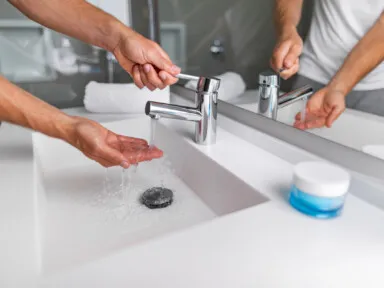
Homeowners know that hard water, water rich in calcium and magnesium, can be a nuisance that leads to tricky scale build-ups and dry skin. If you’ve ever noticed a film on your glassware, that’s just one of the common signs of hard water. The right water softening system helps prevent expensive plumbing bills and leads to fewer headaches.
While many homes with hard water will install a traditional water softener, salt-free water softeners, also known as water conditioners, are an appealing option for homeowners seeking a sustainable and low-maintenance solution to help prevent scale buildup. For health-conscious families, there’s the added benefit of no sodium being introduced into their drinking water.
Wondering which system is best for your home? At Leaf Home, we understand the challenges of finding the right home water systems and are here to walk you through the benefits and setbacks of salt-free water conditioners so you can make the most informed decision for maximizing your home’s water quality.
In this article:
- What Is a Salt-Free Water Conditioner?
- Pros of Salt-Free Water Conditioners?
- Cons of Salt-Free Water Conditioners?
- Salt-Free vs Salt-Based: Which Is Right for You?
- Frequently Asked Questions
What Is a Salt-Free Water Conditioner?
When it comes to reducing scale buildup in your home, salt-free conditioners and traditional salt-based softeners are the two most common methods, and they work in distinctly different ways.
How Salt-Free Water Conditioners Work
Salt-free water conditioners are unique in that they don’t use ion exchange, but instead rely on a process called Template Assisted Crystallization (TAC), which provides nucleation sites that change how the minerals crystallize when they come out of solution. After TAC, the minerals are unable to attach to surfaces, helping prevent scale buildup. This is why salt-free conditioning systems are considered conditioners, because they neutralize hardness minerals without removing them.
Salt-Free vs Salt-Based Water Conditioners
Traditional salt-based systems use salt and ion exchange technology, where resin beads swap calcium and magnesium ions for sodium ions, helping remove hardness minerals from the water. The water quality from this process results in a noticeably softer feel, which may even be slippery to the touch. It’s beneficial for the dishwasher as it helps detergents and soaps to lather more effectively. These systems have higher maintenance costs, as regular salt refills, resin cleaning, and brine wastewater must be discarded.
Meanwhile, with salt-free conditioners, water maintains its mineral content, but the conditioned minerals are less likely to form scale buildups, resulting in fewer calls to the plumber and an extended lifespan for water-based appliances and water heaters.
The touch of the water might not feel softer, and soap performance may vary, but the reduction in maintenance is significant. With no salt to replenish or brine to discard, the commitment and cost of maintaining these systems is attractive to many households.
| Feature | Salt-Free Conditioner | Salt-Based Softener |
| Removes Hardness Minerals | ❌ No | ✅ Yes |
| Prevents Scale Buildup | ✅ Yes | ✅ Yes |
| Adds Sodium | ❌ No | ✅ Yes |
| Maintenance Required | ✅ Low | ☑️ Medium |
| Electricity Needed | ❌ No | ✅ Yes |
| Suitable for Septic Use | ✅ Yes | ⚠️ It depends |
Pros of Salt-Free Water Conditioners
Lower Maintenance
One of the best things about a salt-free water conditioner is that it requires less maintenance and has a long lifespan. There’s no need to worry about refilling salt every month or cleaning out brine tanks, which keeps costs down in the long term. The presence of a salt-free conditioner helps prevent scale buildup in pipes and appliances, meaning water-based appliances, such as dishwashers, laundry machines, and water heaters, will last longer. Salt-free water conditioners are an effective and efficient option for reduced maintenance.
Environmentally Friendly
One of the primary advantages of salt-free water conditioners lies in their operational efficiency and environmental friendliness. Unlike traditional salt-based softeners, these systems do not undergo regeneration cycles. This absence of regeneration means that no water is wasted in the backwashing process, which is a significant benefit in areas concerned with water conservation.
No Added Sodium
Salt-based systems add sodium to the water, which can be problematic for health-conscious users or those on low-sodium diets. A salt-free system means never having to worry about unwanted sodium and enjoying the essential minerals that are left behind..
Smaller Footprint
The eco-conscious salt-free water system uses less electricity and requires less space in the whole house. A single tank or cartridge is all salt-free water conditioners need. Traditional water softeners use two tanks, one for the salt and the other for the resin, while also needing a drain connection for the backflushing. Many households enjoy the extra space and lower utility costs of water conditioners.
Cons of Salt-Free Water Conditioners
While salt-free conditioners offer clear advantages in space and efficiency, it’s important to weigh these benefits against the drawbacks of salt-free systems.
Doesn’t Remove Hardness Minerals
It’s important to remember that TAC doesn’t physically remove the minerals calcium and magnesium; it instead changes their structure. Scale prevention may not be complete, but it is easier to remove because the altered crystal structure makes scale less sticky. Water treated by a salt-free system may still test as hard, but the minerals that remain behave differently.
Not Ideal for Very Hard Water
Some states with very hard water conditions may have mineral contents too high for water conditioners to be effective. In this scenario, homeowners may still see scale build ups and hard-to-remove water stains. Traditional water softeners or salt-based water systems may be necessary to help prevent unwanted plumbing issues. To identify if a water system is too hard for a salt-free conditioner, the water experts at Leaf Home can measure your water’s mineral levels in a free water test and help determine which treatment approach is best.
Doesn’t Provide the “Soft Water Feel”
Homeowners seeking the slippery smooth wetness from their water treatment could find a salt-based system lacking. The presence of hardness minerals prevents the drinking water from taking on the textures that traditional softeners create. However, those wanting to improve the taste and smell of their tap water may consider weighing the benefits of a water filter vs water softener.
Higher Upfront Cost
Salt-free water treatment systems may cost more upfront than basic ion-exchange models because they require more complex technology and higher-quality materials. Still, the longer-term maintenance is less expensive and demanding than traditional salt-based water softener, and can vary depending on what size water softener your household needs.
Salt-Free vs Salt-Based: Which Is Right for You?
When deciding which water softener system is right for your household, it’s helpful to consider personal preferences, health requirements, and water hardness. For those seeking to keep their sodium levels low and their energy bills down, a salt-free water conditioner may be the best water system for their home. Households in areas with extremely hard water may choose a traditional water softener system using ion exchange to help prevent scale buildup and keep plumbing repair costs down.
Learn More About Leaf Home Water Solutions Salt-Free Water Conditioners.
Frequently Asked Questions
Do salt-free conditioners really work?
Yes. Leaf Home Water Solutions’ salt-free water conditioner is an effective salt-free alternative for reducing the scale formation caused by hard water, though they work differently than salt-based water softeners. They use Template Assisted Crystallization (TAC) to change how minerals crystallize, making them less likely to stick to surfaces. While they don’t remove any hardness minerals, they change how those minerals behave, reducing scale buildup.
Can I use a salt-free conditioner with well water?
Salt-free conditioners are typically usable with well water and effective for scale prevention, but depending on the hardness of the well water, a traditional softener may be more beneficial. Wells may have contaminants such as iron, sulfur, and sediment that can affect TAC systems or require pre-treatment. Learn more about well water solutions.
Will salt-free conditioning systems remove limescale?
No, salt-free conditioners cannot address existing limescale buildup. The good news is salt-free softeners can help prevent limescale from occurring in the first place. By changing how magnesium and calcium crystallize, scale buildups are less likely and easier to remove.
Are salt-free conditioning systems easier to install?
The smaller, more compact footprint of a salt-free conditioner makes it easier to install. Additionally, they can often be installed to existing plumbing and do not require a drain connection for backwashing.