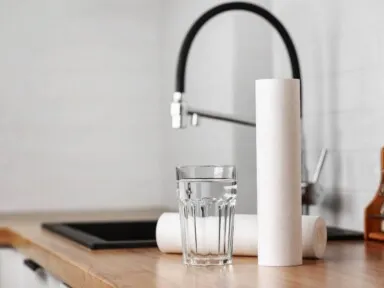
Reverse osmosis (RO) is technically a type of filtration, but it works very differently from the carbon or sediment filters most people think of. Standard filters rely on media like carbon to reduce chlorine, odors, and selected contaminants, while RO forces water through a semi-permeable membrane that removes many dissolved substances.
The biggest distinction is where they’re used: RO is almost always a point-of-use (POU) system installed at a single tap, while carbon and other media filters are more often used as point-of-entry (POE) systems to treat water for the whole home. If you want high-purity drinking water at one faucet, RO is usually best; if you want better taste and odor at every tap, a whole-home filter is often the better fit.
This article compares RO vs. other water filtration types, showing what each can and can’t remove, and walking you through common scenarios to help you choose the right option for your home.
In This Article:
- Why Treat Tap Water?
- Different Types of Water Filters
- How Reverse Osmosis Works
- How Non-RO Filtration Works
- RO vs. Filtration: What Each One Removes
- RO vs. Filtration: Which One Should You Choose?
- Frequently Asked Questions
Why Treat Tap Water?
No matter the source, unfiltered tap water often contains issues. City water is treated by municipalities to meet EPA standards, but it may still taste like chlorine or pick up contaminants like lead from plumbing. Well water, drawn directly from the ground, can contain contaminants, heavy metals, sediment, sulfur, and microbes. Regular testing helps identify these risks, allowing you to choose a filter specifically designed to address those concerns.
How to Treat City vs. Well Water
City water can contain residual disinfectants like chlorine and chloramine, and in some cases lead, fluoride, or PFAS (“forever chemicals”) from pipes or industrial runoff. Even though it’s regularly tested, you may want home water filtration for aesthetic or health reasons. Your local supplier’s Consumer Confidence Report (CCR) provides up-to-date details on what’s in your water.
Well water is not regulated, so treatment is up to the homeowner. Because it comes untreated from the ground, it often contains sediment, sulfur (when water has a rotten-egg odor), bacteria, and heavy metals. These well water contaminants can make you sick if left in the drinking water, so testing regularly is essential. The CDC recommends testing at least once a year,or more frequently if there are quality changes, well damage, or flooding. In-home water filtration can remove many of these contaminants, improving odor, taste and safety.
Different Types of Water Filters
All water filters remove contaminants, but each type serves a different purpose. Each one uses a unique method for removing impurities, and its effectiveness depends on the composition of your tap water. Filters are typically installed as either point-of-use (POU) systems, which filter water at a single tap (like your kitchen sink), or point-of-entry (POE) systems, which treat all the water entering your home.
- Activated carbon: Activated carbon filters are porous and absorb contaminants such as volatile organic compounds (VOCs), chlorine, and other pollutants that affect the taste or smell of water. A certified carbon block filter can also reduce things like lead or cysts like Giardia.
- Catalytic carbon: Similar to activated carbon, catalytic carbon also improves the taste and odor of water while also removing contaminants such as chloramine and hydrogen sulfide.
- Sediment: Sediment filters utilize a micron rating system to indicate their ability to remove physical contaminants, such as silt, dirt, and sand. The lower the micron rating, the smaller the contaminant it can filter. A rating of one, for instance, can remove things like parasites.
- Ion exchange (water softener): These softening systems don’t remove contaminants, but instead use ion exchange to replace hardness minerals (calcium and magnesium) with sodium or potassium to reduce scale buildup.
- Membranes (like Reverse Osmosis): Each of these filter types (micro/ultra/nano/RO) uses a membrane with fine pores to prevent contaminants from passing through. Reverse Osmosis (RO) has the smallest pores of these types, and micro has the largest. Some of these types can even remove things like arsenic and nitrates, as well as other total dissolved solids (TDS).
- Ultraviolet: In addition to water filtration systems, a UV system can disinfect the water by using UV-C light to neutralize harmful microorganisms.
How Reverse Osmosis Works
As a membrane water filter, RO works as a water sieve. First, the water is fed through a sediment pre-filter to remove large contaminants, and then a carbon filter to remove things like chlorine. Next, the water is pushed through the RO membrane. Any molecules larger than water cannot pass through,so only purified water remains on the other side of the membrane.
Finally, the water will often pass through a post-carbon filter to improve taste and smell. A remineralization filter can also be added to replenish the beneficial minerals that were removed, such as calcium and sodium.
What Reverse Osmosis Removes
Multi-stage RO systems like the ones offered at Leaf Home are effective in removing contaminants such as lead, arsenic, copper, fluoride, nitrates/nitrites, chlorine, and total dissolved solids, as well as “forever chemicals” like PFAS (PFOA/PFOS). As a note, RO is not a primary disinfectant and should be integrated with a UV or other disinfectant system for proper water disinfection.
How Non-RO Filtration Works
Activated carbon
When city water quality is generally safe but unpleasant to drink and you want to improve the taste and smell of your home’s drinking water, activated carbon filters are often the way to go.
Per the CDC, these ordinary filters are also helpful for reducing certain heavy metals like lead and residual disinfectants like chlorine. What they can’t do is remove dissolved contaminants like arsenic, nitrates, or PFAS. That’s where reverse osmosis (RO) goes further.
Other media
In addition to carbon filters, there are several other types of water filters to consider.
- Catalytic carbon: Although they use carbon, catalytic carbon filters accelerate a chemical reaction to break down contaminants such as chloramine and hydrogen sulfide.
- Ion exchange: Also known as a water softener, ion exchange works by utilizing charged resin beads to bind to hard water minerals, removing them from the water.
- Sediment: Like a sieve, sediment filters work by blocking physical contaminants like silt and dirt from the water as it passes through.
POE whole-house filters
Point-of-entry filters treat water as it enters your home, improving quality everywhere from sinks to showers. These systems are more expensive upfront, but last longer and require less maintenance than point-of-use filters. Whole-house systems typically use carbon, catalytic carbon, or softening media — while RO is usually installed as a POU system at specific taps for higher-purity drinking water.
POU point-of-use
POU filters clean water at a single tap or faucet, making them easy to install and less expensive than a full home system. They allow homeowners to target where they want filtered water most, such as in the kitchen. The most common POU filters include countertop, faucet, refrigerator, and undersink models (common for RO).
RO vs. Filtration: What Each One Removes
Since not all water filters can remove the same contaminants, we created a chart for quick reference of each significant water issue or contaminant, along with the main filter types, to demonstrate which ones are effective against each issue. Note that some filter types have only specific models that effectively remove or address the given contaminant.
| Contaminant / Issue | Reverse Osmosis (RO) | Carbon Filters | Ion Exchange (softener/resin) |
|---|---|---|---|
| Chlorine (taste/odor) | ✓ (post-carbon) | ✓ | — |
| Chloramine | ~ (with adequate carbon pre-treatment) | ~ | — |
| Lead | ✓ | ✓ (53-certified carbon/block) | ~ (select resins) |
| Fluoride | ✓ | — | — |
| Nitrate/Nitrite | ✓ | — | ~ (select anion resins) |
| Arsenic | ✓ | ✓
(some, not all) |
~ (specialty media) |
| PFAS (selected) | ✓ | ✓ (model-specific) | — |
| VOCs / Pesticides | ✓ | ✓ (model-specific) | — |
| TDS (overall) | ✓ | — | — (doesn’t reduce, just swaps hardness) |
| Hardness / Scale | ~ (reduces TDS but not ideal for whole-home) | — | ✓ (softening) |
| Turbidity / Particulates | ~ (pre-filters handle it) | ✓ (with block) | — |
| Cysts (Crypto/Giardia) | ✓ (model-specific) | ✓ (model-specific) | — |
| Bacteria/Viruses | ~ (reduction; not primary disinfection) | — | — |
RO vs. Filtration: Which One Should You Choose?
When exploring water filter options, your home’s water will often determine what you need. If you have treated city water, for example, a carbon filter to improve taste or odor is usually sufficient. However, if you live in an area with older plumbing, a potential for lead service lines, or high total dissolved solids (TDS), a RO system is excellent for addressing those issues. For those with private wells, you may want to consider a POE system with sediment filtration and, perhaps, even a UV filter to disinfect if there is a high risk of bacteria or microbes in your area.
For many homeowners, the solution may be a combination of systems to suit their home’s unique needs. To get a full scope of the quality of your water, contact our local water experts at Leaf Home for a free, comprehensive water test. From there, they can help you determine what advanced filtration option is best for your water situation.
Frequently Asked Questions
Is reverse osmosis better than filtration?
Reverse osmosis, or RO, is a form of water filtration. It acts similarly to a sieve, using a membrane that only allows water-sized ions to pass through, keeping the contaminants on the other side. It is a highly efficient way of filtering water to a high level of purity.
What are the disadvantages of reverse osmosis?
The two most significant disadvantages to RO are the amount of water waste created in treating the water and the reduction of essential minerals in the water. However, RO-treated water can be remineralized to replenish the healthy minerals that were removed.
Does a reverse osmosis water filter remove chlorine from water?
Yes. Often in an RO system, the chlorine is removed by the pre-filter, which is carbon-based. When it reaches the membrane filter, the chlorine should already be removed.
What are the key differences between reverse osmosis and standard water filtration?
The primary difference between RO and other water filtration systems is the semi-permeable membrane. RO is able to achieve nearly pure water because the membrane does not allow any ions to pass through that are larger than a water ion. While most filters rely on a single stage of media (such as carbon) to reduce chlorine, odors, or some chemicals, RO systems push water through a membrane fine enough to block dissolved salts, heavy metals, and other contaminants. RO units also use multiple stages — typically a pre-filter, the RO membrane, and a post-filter — to deliver nearly pure water, whereas standard filters usually treat water in just one step.