Discover the origins of soap scum, spots on your glasses, and more – and see how Leaf Home can help you soften the water in your home.
You’ve likely heard about hard water and its possible effects on your home, such as buildup in your pipes or spots on your drinking glasses. While it’s important to note that hard water poses no significant health risks, water hardness can impact how you feel after a bath or shower, the taste of your drinking water, and more. Today, we’ll explore the water hardness scale, the impacts of water hardness, and the various ways to test and manage water hardness.
In this article:
- The Science of Water Hardness
- The Water Hardness Scale
- Impacts of Water Hardness
- Testing Water Hardness
- Managing Water Hardness
- Why Leaf Home Water Solutions?
- Frequently Asked Questions
The Science of Water Hardness
While the terms “hard water” and “soft water” may sound confusing, the presence of hard or soft water doesn’t pose a threat. In fact, nearly 85 percent of homes in the United States have hard water. Cities like Indianapolis, Tampa, Las Vegas, and Phoenix have some of the hardest water in the country, given their deposits of limestone in the ancient seabeds located in those regions.
So, what causes water hardness, and how is it measured? Let’s take a deeper look at the minerals that differentiate hard water from soft water before jumping into how water hardness is measured.
Minerals contributing to water hardness
Water hardness is defined by the amount of calcium and magnesium dissolved in the water. Hard water has high amounts of dissolved minerals, particularly calcium and magnesium. These deposits create the spots and specks homeowners find on their dishes and glasses when they take them out of the dishwasher. That doesn’t necessarily mean that your dishes or your skin are unclean, but it will require more soap and detergent to remove the film or “scum” from the affected surface.
It should be noted that while calcium and magnesium can create cloudy drinking water and cause buildup in appliances, such as hot water heaters or even coffee makers, hard water does not pose significant public health risks. Whether your home uses city water or well water, the water hardness is largely determined by the source of the water itself and the minerals present within that water source.
How water hardness is measured
Water hardness is measured by taking the concentration of calcium carbonate or the calcium carbonate equivalents for a unit of water. There are a few ways to measure these concentration levels. One way is in grains per gallon, or gpg, which measures how many grains of calcium carbonate are present in a gallon of water.
Another way of measuring water hardness is by using parts per million, or milligrams per liter (mg/L), which are equivalent to one another. This takes into account how many milligrams of calcium carbonate are present in the water. In accordance with the Water Quality Association, we will use mg/L when describing the water hardness scale in the next section.
The Water Hardness Scale
Since all water starts as groundwater or surface water, it will contain grains of minerals. The presence of calcium and magnesium determines the hardness of your tap water. The more calcium and magnesium present in the water, the harder the water is.
Because hard water tends to damage equipment such as pipes, washing machines, dishwashers, and more, it’s in the best interest of homeowners and local industries to use water softeners to achieve softer water. But how do you know whether you have soft water or hard water? It all depends on the water hardness scale. According to the U.S. Geological Survey, water hardness can be defined as follows:
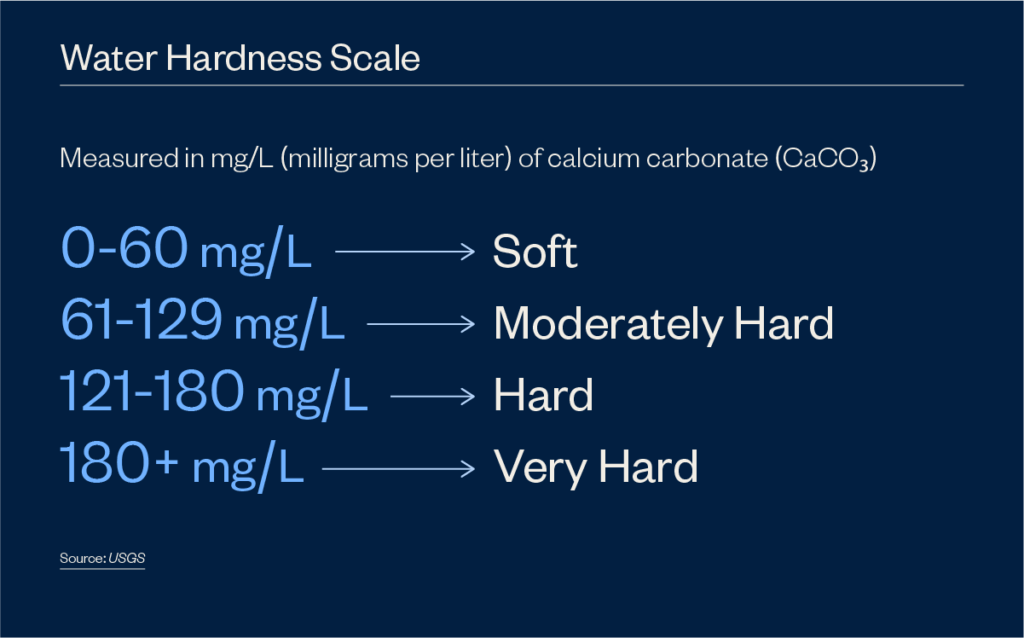
Soft Water (0-60 mg/L)
Soft water obviously contains fewer grains of calcium and magnesium than harder water. Soft water appears in locations with peat or igneous rock sources and may also be found in locations with large amounts of granite or sandstone.
Naturally, soft water typically has lower concentrations of sodium chloride and a low concentration of calcium carbonate. Water softeners often add sodium to harder water to replace the minerals present with sodium ions and create the softening effect.
Moderately Hard Water (61-129 mg/L)
Moderately hard water isn’t necessarily a cause for concern, as it’s relatively close to the amount of minerals found in mountain springs and other forms of natural drinking water. It is considered high-quality drinking water.
Hard Water (121-180 mg/L)
Hard water is heavily concentrated in minerals like calcium carbonate. Both calcium and magnesium are found within the Earth’s crust. When rainwater moves through natural rock formations, it will pick up these minerals, particularly as it travels through limestone and other types of rock heavily concentrated in calcium and magnesium. Signs of hard water include limescale buildup in pipes, dry or irritated skin, stained sinks and tubs, and mineral deposits on faucets or showerheads.
Very Hard Water (more than 180 mg/L)
Very hard water has the greatest concentration of calcium carbonate and contains over 180 mg/L or over 7 grains per gallon. Very hard water requires water softeners to preserve appliances and prevent skin irritation. Signs of very hard water include a “soap scum” feeling on the surface of the skin, faded clothes, soap that won’t lather, hard-to-clean limescale in the shower, and the frequent need for plumbing repairs.
Impacts of Water Hardness
While water hardness does not pose dangerous health risks, knowing how it will impact your daily life is important. Understanding the effects of hard water can help you make the best decision for your home and your family regarding water treatment and softening solutions.
Effects on Health
While water hardness is unlikely to cause severe health issues, it can affect you and your family’s comfort in many ways. The harder your water is, the more likely you are to experience a film or “scum” feeling on your skin, which can lead to dry, irritated skin over time. More soap is required to remove the film left behind by hard water, which can inevitably result in more irritation.
Perhaps one of the more unfortunate results of hard water is damaged hair. Excess calcium and magnesium prevent hair from receiving the nourishment it needs, leading to dull, brittle hair that becomes increasingly difficult to manage and more susceptible to breakage.
Household Impacts
The most common complaint from houses with hard water is the negative impact on household appliances. Mineral deposits will begin to show on your faucets and showerheads, and you may begin to notice buildup in your coffee maker as well. Over time, this buildup can lead to foul-tasting water that is difficult to ingest.
Scale buildups in your plumbing can also become quite a nuisance. The more minerals that are present in your water, the higher the chance of clogging and corrosion. Plumbing repairs can be quite costly, so it’s in your best interest to ensure you have the proper water treatment and purification system to protect your bottom line.
Testing Water Hardness
There are a variety of ways to test the hardness of your water so that you can make the best decision for your household and your family.
Home Testing Kits
Home testing kits are available at your local home improvement store or online. They cost anywhere between $5 and $20 and often produce an easy-to-read result right away. The testing kits include easy-to-read strips that will provide you with the hardness of your water, and many also include levels of chlorine, nitrates, and more.
Laboratory Testing
For a more in-depth look at your drinking water and its properties, you can have your water sent off to a third-party laboratory for testing. This type of testing can identify a wider range of contaminants and provide precise measurements for minerals, metals, and other water quality indicators. While at-home tests are affordable and provide quick, reliable results for most households, lab testing is worth considering if you suspect lead, bacteria, or other serious contaminants.
You can also skip the guesswork with a free in-home water test from Leaf Home Water Solutions. Our experts test your water on the spot and recommend tailored solutions to help protect your home, health, and appliances.
Managing Water Hardness
Fortunately, managing water hardness is not an impossible task. Several options are available to soften your water and ensure it is ideal for drinking, bathing, and more. Typically, two options are available to combat hard water:
- Sodium ion exchange water softeners: These softeners substitute sodium for the minerals that make water harder. These are the most commonly used water softener systems, and they work by drawing the calcium and magnesium into a resin and then exchanging those minerals for sodium. This will produce trace amounts of sodium in the water, though the levels are within the recommended range for healthy adults.
- Salt-free water conditioner: As opposed to removing hardness minerals, salt-free water conditioners convert them into microscopic crystals, making them much less likely to form scale. This solution is a great option for those on low-sodium diets or those who are wary of increasing sodium levels in their water. Leaf Home’s salt-free water conditioner is designed for homeowners seeking a sustainable and low-maintenance solution to hard water problems.
Why Leaf Home Water Solutions?
While hard water does not necessarily pose a threat to your health, it can negatively impact your plumbing and create discomfort for you and your family. The various treatment options, from water softeners to reverse osmosis systems to distillation, can become a bit overwhelming. That’s why Leaf Home Water Solutions is here to help.
Schedule a free in-home water test and let us find the best water treatment solution for you.
Frequently Asked Questions
At what hardness is a water softener needed?
A water softener is typically needed when water hardness exceeds 120 mg/L. Hard water at this level can cause mineral buildup in pipes, appliances, and fixtures, reducing efficiency and causing potential damage over time. Regular testing of water hardness can help identify when a water softener is necessary to prevent these issues.
How can I test water hardness?
There are several ways to test for water hardness. The simplest way is to head to your local home improvement store and purchase an at-home testing kit. Third-party laboratories will also test water for you. Leaf Home Water Solutions offers a free in-home test and provides assistance in determining which water purification solution is best for your home.