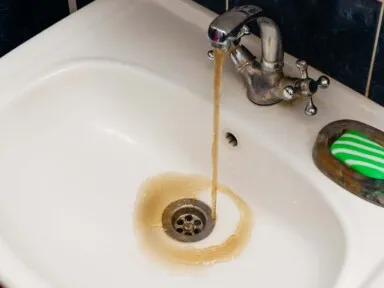
Seeing your tap water suddenly coming out brown or orange can certainly be alarming, but in most cases, it’s a solvable problem caused by iron, manganese, or rust particles that get stirred up in the water supply. While the discoloration is often temporary, it can stain fixtures, damage laundry, and point to problems in your plumbing system or municipal water lines.
Brown water usually clears on its own, but it is still important to know what caused it and how to respond. Until you know the source, it’s best to avoid drinking or cooking with discolored water. This guide explains the most common reasons for discolored water, how to narrow down the source, whether brown water is safe to drink, and what treatment options work best.
In This Article
- Fast Diagnosis: What Does Brown Water In Your Home Mean?
- Options for Treating Brown Water
- Is Brown Water Safe to Drink
- What Causes Brown Water In Your Home
- How to Test and When to Call a Professional
- Frequently Asked Questions
Fast Diagnosis: What Does Brown Water in Your Home Mean?
Not every case of brown water has the same cause. According to the EWG, there are several common reasons for discolored water across U.S. water sources. Before panicking, here are a few simple checks that can help you quickly narrow down what may be causing your brown water.
Color and Timing Clues
The look and timing of discolored water can give you quick hints about where the problem starts. To help you figure out how far up the issue is in the supply line, ask yourself: Is the issue inside your plumbing, in your water heater, or somewhere in the supply coming into your home? A closer look at the color and when it appears can help you narrow down the likely cause.
- Orange to brown water usually points to iron or manganese.
- Yellow to brown water or other discoloration that clears after the water runs for a minute suggests sediment in your pipes.
- Darker water with tiny particles may be an indication of lead.
- Brown water that shows up only at certain times of day may align with utility flushing or pressure changes in the water system.
Hot vs. Cold Test
Run both hot and cold taps. If only hot water looks discolored, sediment in your hot water heater is the likely culprit. Flushing the hot water tank or replacing a corroded anode rod can often solve the issue. But if rust keeps coming back, or if the tank itself is corroding, that’s a sign the water heater may be reaching the end of its life and could need full replacement.
If both hot and cold water show brown color, the source is probably the municipal supply, well water, or your in-home pipes.
One Fixture vs. Whole Home Discoloration
If brown water appears at just one faucet, check the aerator or shower head for rust particles. Cleaning aerators and flushing that fixture may solve the issue. If the entire house has discolored water, the cause is upstream in the main supply or well.
Options for Treating Brown Water
Fixes for brown water don’t need to be complicated, but they do need to match what’s actually in your water. That’s why a water test matters, and Leaf Home makes that easy and free. While the following methods serve as a guideline for treating brown water, we recommend consulting with a professional before attempting any water treatment.
| Recommended Method | Water Source | Directions and Relevant Information |
|---|---|---|
| Flush and clean | City & Well | Let cold water run for 5–10 minutes, pause laundry, and clear out faucet aerators. It often clears things up right away. |
| Water-heater service | City & Well | If only your hot water is discolored, drain the tank or swap out a worn anode rod. |
| Sediment filtration | City & Well | Simple filters (5–20 µm) catch rust flakes and grit, providing quick, affordable relief. |
| Activated carbon filtration | City & Well | Helps reduce chlorine, stale tastes, and some organic materials. Choose between whole-home systems or under-sink models, depending on where you need clarity most. |
| Catalytic carbon | City | If your town uses chloramine, you’ll see better results with catalytic carbon—specifically designed for that disinfectant loop. |
| Oxidation + filtration | Well | For iron or manganese in well water, systems that use air injection or greensand convert minerals so they can be filtered out cleanly. |
| Ion-exchange softener | City & Well | Great for hard water and low-level ferrous iron — but not the answer for heavy iron, manganese, or tannin issues. |
| Shock chlorination | Well | A focused, one-time disinfect — and often the start of a lower-maintenance, cleaner future for bacteria concerns. |
| Point-of-use reverse osmosis | City & Well | Under-sink RO systems deliver purified drinking water right where you eat and cook. Leaf Home offers advanced RO systems that help remove PFAS, heavy metals, and other hard-to-remove contaminants. |
| Pipe or material upgrades | City & Well | If corrosion is inside your pipes, the permanent solution is replacing galvanized or cast-iron sections — paired with filtration for lasting results. |
| Whole-home filtration systems | City & Well | For complete water clarity across your house, Leaf Home offers custom-designed water filtration systems. Our water experts tailor a solution after digital testing, so you get the right mix — whether it includes carbon, softening, reverse osmosis, UV, or other technologies. |
Is Brown Water Safe to Drink?
The short answer is: sometimes, but caution is best.
The U.S. Environmental Protection Agency (EPA) sets secondary drinking water standards for iron and manganese, which are based on taste, color, and staining rather than health risks. At low levels, these minerals are not considered harmful. Still, you should avoid drinking or cooking with discolored water until you know the source.
Manganese deserves special attention. While usually an aesthetic issue, high levels can pose a health risk, especially for infants. Corrosion is another concern. Brown water caused by rusty pipes may occur alongside lead leaching if your home has lead or galvanized steel service lines. If you suspect this, use only cold water for cooking or drinking and arrange for a water test.
For more details on possible contaminants, see Leaf Home’s guide on water contamination symptoms.
What Causes Brown Water in Your Home
Discolored water can come from either the city supply or a private well. Each system has its own triggers, and knowing which you rely on helps you understand the likely cause. In both cases, iron, manganese, or rust particles are the usual culprits. These minerals are naturally present in groundwater and can also build up in metal pipes; when they’re disturbed, they give water a yellow, orange, reddish-brown, or sometimes black tint.
Both city systems and private wells can also deliver brown water after pressure changes or maintenance work. Where they differ is in the source: city water discoloration often comes from utility work or aging mains, while well water issues tend to come from naturally occurring minerals, bacteria, or shifts in the groundwater table.
What Causes Brown City Water
City water runs through a large distribution system, which means a disturbance anywhere along the way can lead to discoloration in your home. Common causes include:
- Hydrant flushing or valve work: Utilities flush fire hydrants or perform maintenance that stirs up iron and manganese sediment in the mains. This can temporarily cause brown or rusty water at your taps. It usually clears within a few hours once the water runs clear again.
- Water main breaks: A break or sudden pressure change can release rust particles from old pipes, causing widespread brown water. Your utility will typically issue notices if this occurs.
- Aging distribution pipes: Older cast iron or galvanized steel lines can corrode, sending flakes of rust into the water supply. Homes in older neighborhoods may notice this more often.
- In-home piping issues: If only one faucet produces discolored water, the problem may be inside your plumbing system. Galvanized steel pipes are known for rust buildup, which can shed rust particles when water pressure changes.
What Causes Brown Well Water
Private wells bring water straight from groundwater, which often contains natural minerals and organic matter, and can sometimes contain contaminants. Causes include:
- Iron and manganese: These minerals are common in groundwater. When exposed to air, they oxidize and turn brown, orange, or black. Staining of sinks and laundry is a typical sign.
- Weather changes: Heavy rainfall or drought can disturb the water table, releasing sediment into your well. Even a pump repair can stir up discolored water temporarily.
- Iron bacteria and tannins: Some well systems develop slimy iron bacteria, or tannins from decaying leaves and organic material. Both can give water a brown or tea-like color.
- Pump or plumbing disturbance: A shift in water pressure during maintenance can dislodge buildup, causing sudden discoloration.
How to Test and When to Call a Professional
The fastest way to figure out what’s behind brown water is to test it. A do-it-yourself kit can give you a rough idea, but a certified test tells you exactly what you’re dealing with. That matters because the right fix depends on both the type of contaminant and how much of it is present.
It’s time to bring in a plumber or water specialist if:
- The water stays brown for more than a day, even after you’ve flushed your taps
- Every faucet shows discoloration instead of just one
- You notice slimy residue, unusual odors, or stains that don’t wash away
- Your home still has older, galvanized, or iron pipes
Leaf Home makes this part simple: we offer free water testing so you can get clear answers before investing in a solution. Our highly trained experts use a state-of-the-art digital photometer, Water View™, to analyze the water in your home. We’ll reveal what’s in your water, in two minutes or less. Then, our experts will help you customize a water system for your home and budget from our over 250 product combinations.
Keeping Your Water Clearer Over Time
Brown water can usually be managed with a mix of regular maintenance and the right equipment. A few simple habits can help:
- Flush taps after long periods of non-use.
- Replace water filters and cartridges on schedule.
- Service your hot water heater every 1–2 years.
- Schedule a water test every year, especially if you use a private well.
- Stay alert to seasonal changes, such as fire hydrant flushing, which can temporarily cause brown tap water.
For more detailed information, see our guide on how to read your water quality report or review US cities with the highest levels of contaminants.
Frequently Asked Questions
Why does brown water only come from one faucet?
This often points to localized plumbing issues, such as rust in a single galvanized steel pipe or buildup in a faucet aerator. Cleaning the aerator or replacing that stretch of pipe may solve the issue.
How long will brown water last after a disturbance?
If caused by hydrant flushing or utility work, brown water typically clears after 20–30 minutes of running taps. In some cases, it may take a few hours. If it lasts longer than a day, call your utility or a plumber.
Can I fix brown water issues myself?
Yes, for minor cases. Flushing your water lines, cleaning aerators, or installing a sediment filter are all DIY-friendly. If the problem continues or stains your fixtures, professional testing and a permanent filtration system are the better options.
How can I prevent brown water in the future?
Keep up with routine maintenance: flush your water heater, replace filters, and schedule yearly water testing. If your home has aging galvanized steel pipes, consider upgrading to modern plumbing to help prevent corrosion.