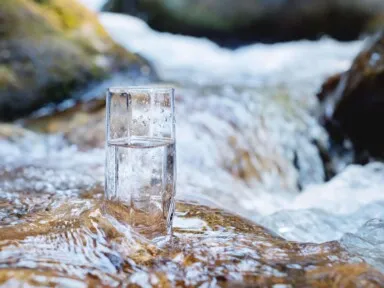
There is nothing like a refreshing glass of water, but not all drinking water is created equal. This is especially true for these two different types of water that are frequently used interchangeably: spring water and purified water. Although both can quench your thirst, one is naturally occurring and the other must be processed.
In This Article
- What Is Spring Water?
- What Is Purified Water?
- Key Differences Between Spring Water and Purified Water
- Choosing the Right Water For Your Home
- Frequently Asked Questions
What Is Spring Water?
Spring water is found naturally. It is groundwater that rises to the surface from an aquifer underground to a spring. According to the U.S. Food and Drug Administration (FDA), only water that comes up naturally from underground to the surface can be referred to as “spring water.”
Further, the FDA indicates that this water must be collected only at the spring or other borehole and labeled with the location of that spring. And when it is treated, it must retain the same quality after the treatment as it did when it was collected. You should not drink water directly from a spring as it can contain bacteria. It is best to purchase it from a store or a water company.
While similar to mineral water, which also comes from underground, natural spring water has access to a natural opening, like a borehole. Per the FDA, mineral water is found underground but is protected and contains mineral content of at least 250 parts per million (ppm) of the total dissolved solids (TDS).
How is Spring Water Obtained?
Spring water can be obtained in three main ways: directly from a natural spring, in bottled form, or through municipal systems that draw from spring sources.
Collecting it directly—whether from a public tap at a protected spring or a private spring on one’s property—offers the most unprocessed form, though it should be tested regularly to ensure safety. A “protected” spring means the surrounding land and infrastructure are managed—often by local or state health departments, environmental agencies, public utilities, or licensed private operators—to prevent contamination. Protected springs typically have posted signage, enclosed or piped access points, and regular water quality testing.
Bottled spring water, regulated by the FDA, must be collected at or near the spring and maintain the same composition as when it emerges from the source. Even so, most bottled spring water undergoes filtration and disinfection before being sealed for sale or home delivery.
In some rare instances, springs feed into public water systems, where the water is treated alongside other sources to meet municipal safety standards. While this water may not be marketed as “spring water,” it shares the same underground origin.
The key to understanding spring water access is that the term refers to its source (an underground formation naturally flowing to the surface) not its treatment method. Whether you’re filling a jug at a local spring, buying a bottle off the shelf, or turning on your kitchen tap, the defining feature is that the water originated from a genuine spring.
Benefits of Spring Water
One of the most significant benefits of spring water is its mineral content. It contains naturally occurring minerals such as calcium, magnesium, and potassium, which can result in a clean and slightly sweet taste. These minerals occur in the water as it passes through layers of rock or soil, where they dissolve. Spring water also benefits from natural filtering. The aquifer, a body of rock or sediment, will filter out some of the contaminants as the water passes through it.
Limitations of Spring Water
The biggest drawback of spring water arises when it’s consumed untreated. This so-called “raw water” can carry harmful bacteria, which can cause illnesses such as cholera, dysentery, and typhoid, according to the Cleveland Clinic. While protected springs are less likely to be contaminated, even they can become unsafe without ongoing monitoring.
There is also variability in the mineral content of spring water based on the environment from which the spring originates and the surrounding geology. Plus, since this water is sourced only from springs, it is more expensive than purified water, which can come from anywhere.
What Is Purified Water?
Purified water is a term that represents a wide range of water sources and treatments. Per the FDA, the term applies to any water that has been treated through distillation, deionization, reverse osmosis, or other approved methods. Purified water can simply be referred to as the treatment type.
The EPA notes that purified water should contain no more than 10 ppm of TDS. Purifying the water, regardless of its source, removes nearly all of the impurities from it, even the minerals, which further differentiates it from spring water.
Here are some of the most common purification methods:
- Deionization: Removes impurities through ion-exchange. As water passes through the collection tanks, ions within the resin in the tanks are charged to attract the ions of the impurities. When this happens, the impurities are traded for beneficial ions such as hydrogen.
- Distillation: In distillation, boiling water is held in one tank, with its subsequent vapor collected as the impurities are left behind. When the vapor cools and turns back into liquid, it is collected separately from the abandoned impurities as pure water.
- Reverse Osmosis: This process works using a semi-permeable membrane that forces the water to separate from its impurities. Since only the water ions can penetrate the membrane and be collected, the resulting water is purified.
Benefits of Purified Water
The most significant benefit of purified water is its consistency. Because this variety of water must go through extensive treatment, it loses nearly all of its impurities and minerals in the process. Unlike spring water, which can vary depending on where it’s from, this water holds a consistent quality, making it especially suitable for households with health concerns.
Limitations of Purified Water
Purified water also removes the helpful minerals, like calcium, which can result in a flat taste. Consuming this water isn’t inherently dangerous, although drinking it in the long term may result in nutritional deficiencies since you aren’t taking in the important minerals. However, eating a mineral-rich diet can help counterbalance low mineral water consumption.
Key Differences Between Spring Water and Purified Water
| Spring Water | Purified Water |
| Comes from springs originating in underground aquifers. | Any water that has been treated with a purification process. |
| Contains various amounts of natural minerals such as calcium, magnesium, potassium and sodium | Contains very little, if any, minerals. |
| More expensive due to its more limited origin. | Less expensive because purified water can come from anywhere |
| Slightly sweet, crisp taste due to minerals. | Can taste bland without minerals. |
Choosing the Right Water for Your Home
Both spring water and purified water can be good options, but the right choice depends on your family’s health considerations, taste preferences, and budget. Spring water offers a natural taste and mineral profile, but it’s typically more expensive and less eco-friendly if you rely on bottled delivery.
On the other hand, purified water can come from your very own tap water with point-of-use or whole-house water filtration systems. If purified water is the right choice for your family or you just want an extra filtration process for your home’s water, be sure to contact the experts at Leaf Home. We can help with everything from testing to installation, so you can enjoy clean, refreshing water straight from your tap.
Frequently Asked Questions
Is spring water safer than purified water?
Both spring water and purified water can be safer and healthier options for hydration. Spring water has the advantage of containing natural minerals, which can be beneficial to health. Purified water in the long term can be harmful to you as it lacks minerals and can cause a nutritional deficiency. Both can be safe if properly treated.
How does the taste of spring water compare to purified water?
Because of its mineral content, spring water is considered to have a crisp taste, whereas purified water is very neutral or flat. Without the minerals, purified water has a consistent flavor profile, but spring water can vary depending on its dissolved mineral content.
Can purified water be harmful due to a lack of minerals?
Because purification removes most of the minerals in water, some studies indicate that long-term consumption may lead to nutritional deficiencies. However, minerals are also abundantly found in the food that we eat, so the harmfulness of purified water is up for debate.
How do I know which water is best for my family’s health?
It depends on the health needs of your family. That said, you can have your water tested for impurities and consult with your trusted physician before making a decision.
Is bottled spring water regulated?
Yes, bottled spring water is regulated by the FDA. According to their regulations, water can only be labeled as spring water if it comes from a natural spring and the name of that spring is identified on the label. However, some companies may use confusing language to label their water as “spring” water when it hasn’t met the necessary regulations. Be sure to look for the name of the spring and any treatment methods, as it may be purified water with “spring” water marketing. You can also look for certification from the International Bottled Water Association (IBWA) or the National Sanitation Foundation (NSF), which can show the water has met the rigorous FDA standards.